






Metal nanostructures and cellulose materials
Group Leader: Ing. Ondřej Kvítek, Ph.D.
Research Focus
Controlled formation of metal nanostructures using solid-state dewetting
- Preparation of thin metal films (Au, Ag; thicknesses in the nanometer range) using PVD methods (sputtering, vacuum evaporation) and investigation of their structure and properties.
- Study of the initial growth phase of metal films; determination of the effective thickness at the percolation threshold via sheet resistance measurements and scanning probe microscopy (AFM).
- Investigation of structural transformations in thin metal films during post-deposition annealing (solid-state dewetting); controlled nanostructure formation; fabrication of bimetallic nanostructures; monitoring changes in the optical properties of thin films.
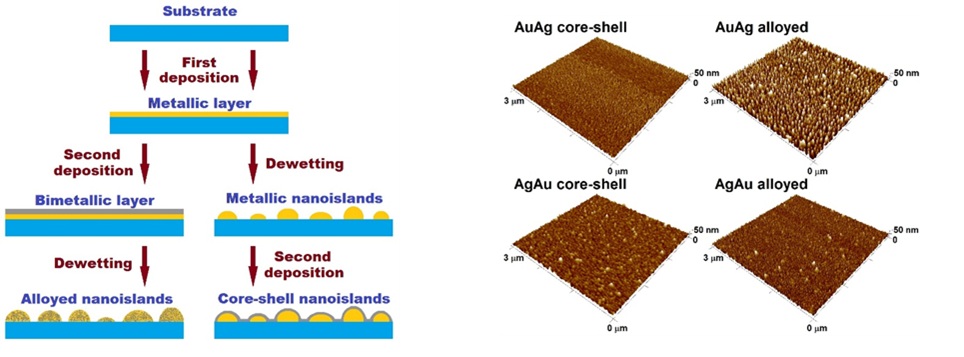
Kvítek O., Havelka V., Veselý M., Řezníčková A., Švorčík V.: Preparation of alloyed and „core-shell“ Au/Ag bimetalic nanostructures on glass substrate by solid state dewetting. Journal of Alloys and Compounds 829:154627, 2020.
Optical detection of gaseous analytes on noble metal nanostructures
Use of metal nanostructures as sensitive layers for gas detection based on changes in their optical properties
- Modification of an experimental setup for the detection of organic solvent and water vapors.
- Detection of changes in analyte concentration based on shifts in localized surface plasmon resonance (LSPR) bands within the UV-Vis spectra of metal nanostructures; detection based on changes in the refractive index of the surrounding medium.
- Enhancement of structure selectivity and sensitivity through the preparation of thin polymer layers on metal nanostructures using spin-coating—selective absorption of the analyte into the polymer layer.
- Development of detection systems featuring multiple distinct sensitive layers (arrays of sensitive layers) for the detection of analyte mixtures.
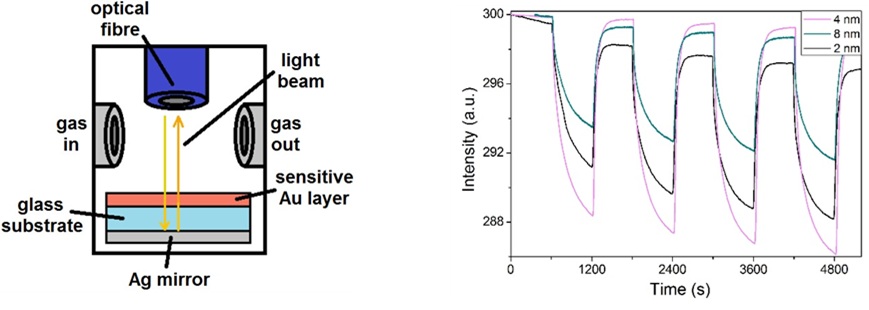
Kvítek O., Kopáček V., Řezníčková A., Švorčík V: Detection of organic vapors on sputtered and annealed thin Au films. Applied Nanotechnology and Nanoscience International Conference 2017, Journal of Physics Conference Series 987:012005, 2018.
Hydrogels based on cellulose derivatives
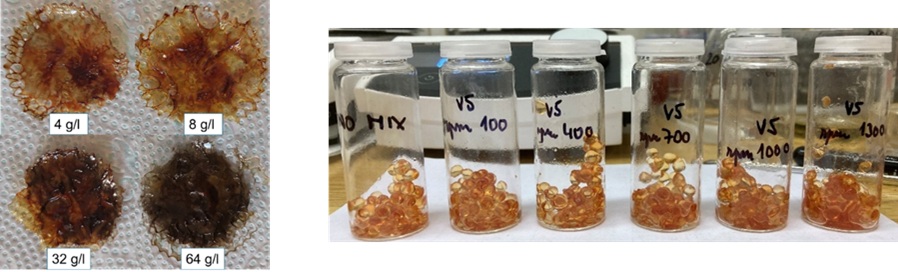
Formation of hydrogels from water-soluble cellulose derivatives—specifically carboxymethyl cellulose (CMC) — using various cross-linking agents: citric acid, aluminum sulfate, and ferric chloride.
- Preparation of Ag nanoparticles via in-situ reduction using citric acid and CMC as a stabilizing agent—with citric acid simultaneously serving as a cross-linking agent and CMC as the hydrogel matrix—along with the study of controlled Ag nanoparticle release (via diffusion from the hydrogel or slow dissolution) and antibacterial properties in collaboration with the Department of Biochemistry and Microbiology at UCT Prague.
- Preparation of hydrogel beads by dropwise addition of a CMC solution to a cross-linking agent solution; in-situ incorporation of active substances during bead preparation or subsequent addition via solution; controlled release of active substances from the beads via diffusion through the bead wall or controlled rupture of the hydrogel bead wall.
Preparation and modification of bacterial nanocellulose properties
Preparation of bacterial nanocellulose via the cultivation of "Komagataeibacter sucrofermentans" bacteria in collaboration with the Department of Biochemistry and Microbiology at UCT Prague; study of the influence of bacterial growth conditions on the properties of the resulting material.
- Incorporation of biologically significant substances—hydroxyapatite, chitosan, and salicylic acid—into the structure of bacterial nanocellulose, and the study of their release from the nanocellulose matrix.
- Development of controllably degradable materials by introducing cellulases into the nanocellulose structure, study of material degradation, and cultivation of skin cells on controllably degradable nanocellulose in collaboration with the Institute of Physiology of the Czech Academy of Sciences.

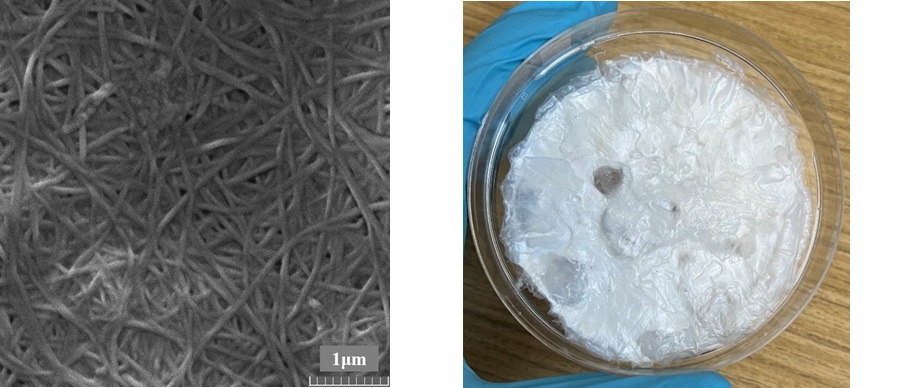
Staňková L., Kutová A., Doubková M., Kvítek O., Vokatá B., Sedlář A., Idriss H., Slepička P., Švorčík V., Bačáková L.: Argon plasma-modified bacterial nanocellulose: Cell-specific differences in the interaction with fibroblast and endothelial cells, Carbohydrate Technologies and Application 7:100470, 2024.